S1S2E vs Rough Sawn Cedar: What's the Difference?
Walk into any BC lumber yard and you'll see the labels: S1S2E, S4S, RGH. They look like part numbers, but they're actually finish codes — and they change how your cedar looks, how big it really is, and what it costs. Here's what they mean, in plain English.
What "S1S2E" Actually Means
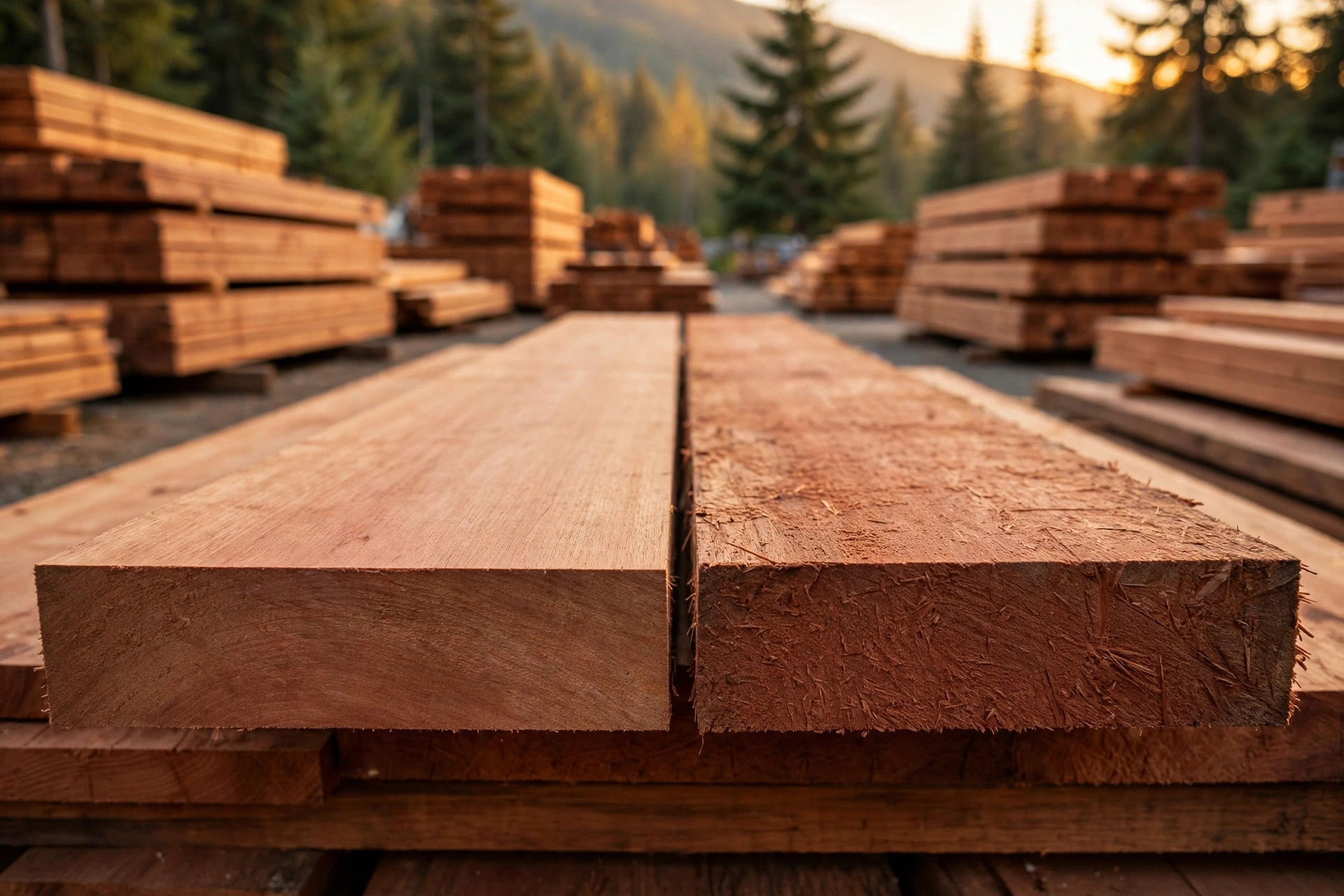
S1S2E stands for Surfaced One Side, Two Edges. At the mill, the board is planed smooth on one wide face and both narrow edges. The remaining face is left with its saw texture — but on a fence board, that rough side simply faces the neighbour's yard or the inside of the project.
S1S2E is the standard finish for cedar fence boards and much exterior trim work across BC, because you only pay for surfacing where it shows. The smooth face takes stain evenly and looks clean from the street.
You'll also see S4S (Surfaced Four Sides): smooth on all faces and edges. S4S cedar is the premium finish for decking, pergola beams, and anywhere both faces are visible or touched. And dimensional lumber like 2x4s and 4x4s is almost always S4S.
What "Rough Sawn" Means
Rough sawn (often written RGH) lumber skips the planer entirely. It leaves the mill with the texture the saw blade gave it — a fine, fibrous, rustic surface on all sides. Rough cedar is the default for rustic projects: barn-style siding, rough pergolas, landscape timbers, garden structures, and acreage fencing where "refined" isn't the goal.
Rough lumber is also typically cheaper than surfaced lumber of the same nominal size, because there's less mill work in every board.
The Size Surprise: Rough Is Bigger
This is the part that trips people up. Surfacing removes wood, so an S1S2E or S4S board is smaller than its name suggests:
- A 1x6 S1S2E fence board measures about 3/4" thick x 5-1/2" wide
- A 1x6 rough board measures closer to 7/8" thick x 5-3/4" wide — sometimes a full 1" x 6"
- A 2x4 S4S measures 1-1/2" x 3-1/2"
- A 2x4 rough measures closer to 1-3/4" x 3-3/4"
That extra meat matters for structural feel, for matching existing rough work on older BC homes, and for coverage math on fences and siding. If you calculate board counts off the nominal size, you'll come up short every time. Measure the actual stock, or ask us — we'll run the numbers with you.
How They Look and Feel
S1S2E and S4S give you the refined face: smooth, splinter-free, crisp edges, even colour. It's what you want where hands touch — handrails, benches, deck surfaces, pergola posts you'll lean against.
Rough sawn has texture and character: subtle saw marks, a matte appearance, and a true West Coast rustic feel. On siding and fences it reads "barn," "cabin," and "heritage." Rough boards can raise slivers, so they're a poor choice for handrails, seating, or anything kids will climb on.
Stain and Paint: Opposite Behaviours
Here's a genuinely counterintuitive point: rough cedar often takes stain better. The open, fibrous surface drinks finish deeply — plan on using noticeably more stain to cover rough lumber than smooth, but the result grips and holds well.
Smooth S1S2E/S4S faces use less product and look more even, but brand-new smooth cedar can have "mill glaze" — a lightly burnished surface from the planer that resists stain until it weathers or gets scuff-sanded. If you're staining new smooth cedar, give it a light sand or a few weeks of weather first, then clean before coating.
Price: What to Expect
Rough sawn is usually the least expensive per board. S1S2E costs a bit more (one pass through the planer), and S4S the most. On big projects — a full perimeter fence on a Kelowna acreage, say — the gap adds up; on a single garden gate, it's negligible. Choose the finish for the job, not the few dollars.
Which Should You Buy? A Quick Guide
- Fences: S1S2E for suburban/modern, rough for rustic/acreage
- Decking: S4S or S1S2E smooth face up — never rough under bare feet
- Pergolas and posts: S4S 4x4 and 6x6 for a finished look; rough for rustic builds
- Siding: either — S1S2E bevel and channel profiles are smooth classics; rough board-and-batten is rustic gold
- Interior feature walls: S1S2E or S4S for easy finishing
What About Interior Projects?
S1S2E and S4S cedar aren't just for exteriors — they're popular for interior feature walls, ceilings, and saunas, where the smooth face takes oil or clear coat beautifully. Rough sawn works for rustic interior accents, but keep it out of saunas and high-touch areas where the textured surface raises slivers. One practical note for interiors: Western Red Cedar has a strong natural scent that most people love in small doses — in a full cedar-clad room, it can be a lot, so test your tolerance with sample boards first.
One Last Tip
Because rough boards are thicker, rough and surfaced lumber don't mix cleanly in the same run — a fence mixing S1S2E and rough boards will show uneven faces and mismatched coverage. Pick one finish per project and buy it all at once, ideally from the same stock run, so colour stays consistent.
Not sure which finish your project wants? Browse our cedar boards in both rough and S1S2E finishes — every product page lists actual dimensions so there are no surprises — or send us your measurements and we'll help you spec it.