
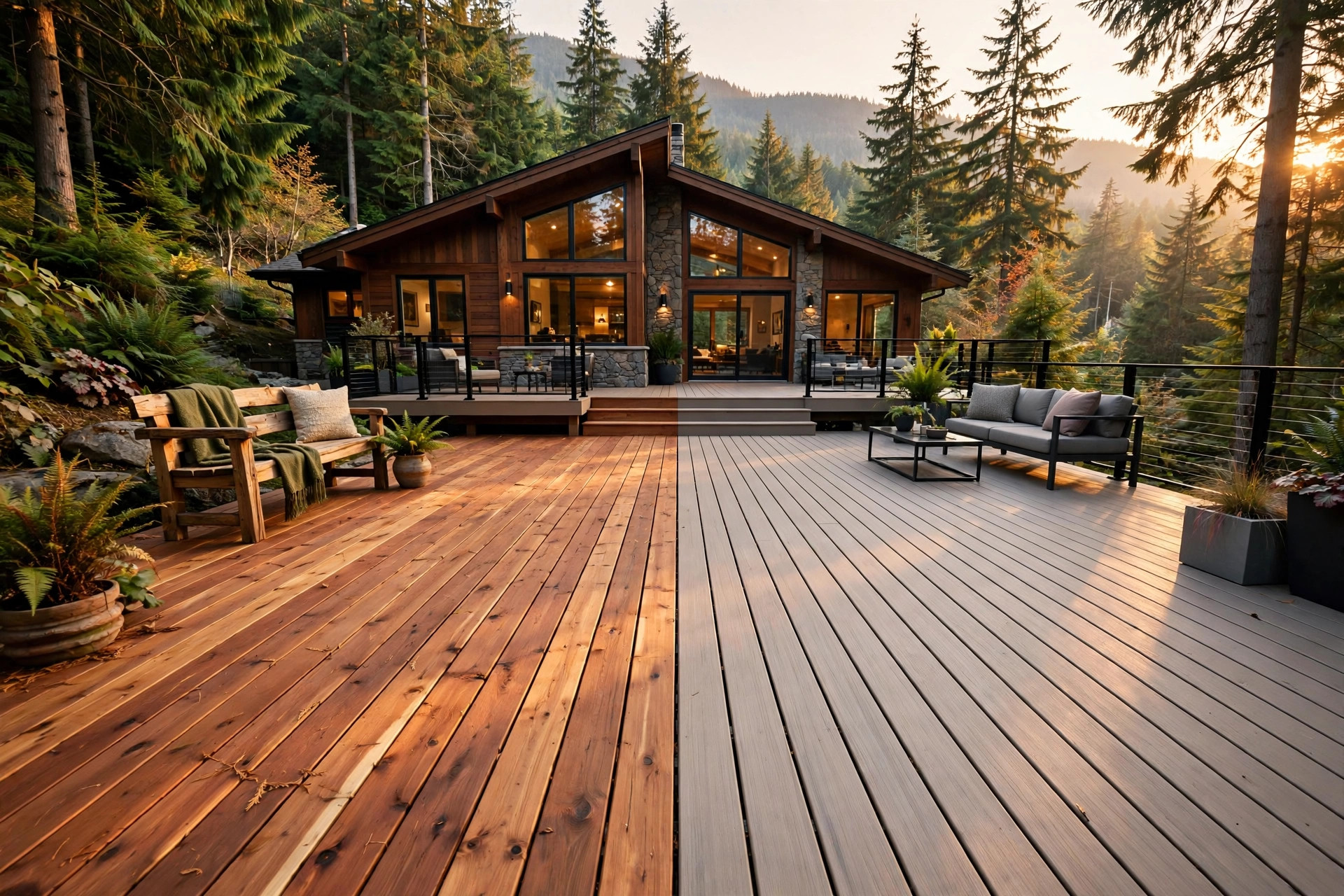
Cedar vs Composite Decking: An Honest Comparison for BC Homes
It's the question every BC homeowner asks sooner or later: should I build my deck with real Western Red Cedar, or go with composite boards? As a cedar lumber supplier — and now a composite decking dealer — we have a foot in both camps. Here's the honest breakdown, no sales pitch.
The Short Answer
If you love the look, warmth, and natural feel of real wood and don't mind a maintenance weekend every couple of years, cedar is hard to beat. If you'd rather never touch a stain brush and are happy paying more up front, composite is your answer. Both can be excellent decks. The wrong choice is picking one without understanding the trade-offs.
Upfront Cost: Cedar Wins Comfortably
This is where cedar's biggest advantage lives. A 5/4 x 6 cedar decking board typically runs well under half the cost of a mid-range composite board of the same length. On a 300-square-foot deck, the material gap can easily be $1,500–$2,500 — and that gap widens on larger builds.
Composite isn't just pricier per board, either. Hidden fastener systems (which most composite brands want you to use), starter clips, and colour-matched fascia add up. Cedar, by contrast, fastens beautifully with conventional deck screws, and a cedar skirt board costs a fraction of a colour-matched composite fascia.
That said, cedar's cost advantage narrows when you factor in maintenance products over the years — which brings us to the next point.
Maintenance: Composite Wins, No Contest
Let's be straight: cedar asks more of you. In the Lower Mainland's nine months of rain, a cedar deck needs a wash and a recoat of stain or sealer roughly every two to three years (every two in the Interior's intense sun, every three on a shaded coastal deck). Skip it and the wood greys, cracks, and checks — still structurally fine, but cosmetically tired.
Composite asks almost nothing: soap, water, a brush, twice a year. No staining, no sealing, no splinters. For the Kelowna cabin you visit on weekends, or the Fraser Valley homeowner who'd rather golf than stain, that matters a lot.
One honest caveat: "maintenance-free" doesn't mean indestructible. Composite still gets dirty, can scratch, and dark colours can fade over time. But day to day, it's the low-effort option.
Lifespan: Composite Lasts Longer
A well-built, well-maintained Western Red Cedar deck in BC lasts 15 to 25 years. The frame (pressure-treated) often outlives the decking, so many homeowners replace just the cedar boards once in a generation.
Composite decking is covered by the manufacturer's warranty, and the boards genuinely outlast cedar. If your horizon is "I want to build this once and be done," composite has the edge.
But note the framing: on a properly built deck, cedar failing at year 20 usually means replacing surface boards, not rebuilding the whole structure. It's not the catastrophe some sales pitches make it sound like.
Look and Feel: Cedar Is Still the Gold Standard
Here's where subjectivity kicks in — but walk barefoot across both on a July afternoon in the Okanagan and the difference is physical. Cedar stays noticeably cooler underfoot than composite, which absorbs and holds heat. Dark composite boards in full sun can be genuinely uncomfortable without shoes.
Cedar also has the grain, the variation, and the smell that no moulded board fully replicates. Modern capped composite is impressively realistic — the best lines fool people from ten feet — but real wood has a depth that catches the eye up close.
Splinters are cedar's one real comfort downside, and they're solved by a smooth S1S2E face and regular sealing. Composite never splinters, full stop.
Performance in BC Weather
The Lower Mainland punishes decks: months of rain, shade, and the moss that comes with both. Cedar handles wet climates well because it naturally resists rot and insects — but it needs that maintenance cycle, and shaded sections need cleaning to stop mildew. Composite shrugs off moisture entirely, which is a real selling point in coastal BC.
The Interior has the opposite challenge: intense summer sun and low humidity. UV is what greys and dries cedar out, so Okanagan decks need stain discipline. Composite's UV inhibitors handle the sun better, though darker colours will still get hot.
One more coastal note: salt air is kinder to capped polymer boards (AZEK's line) than to almost anything else, if your deck sits near the water in places like White Rock or the Sunshine Coast.
The Environmental Angle
Cedar is the greener material, and it isn't close. Western Red Cedar is renewable, largely BC-harvested, stores carbon for its lifetime, and biodegrades at end of life. Composite boards typically contain recycled content (a plus), but at end of life they're landfill — not recyclable in practice, and not compostable. If the footprint of your build matters to you, cedar is the honest answer.
So Which Deck Should You Build?
Choose cedar if: you love real wood, want the lower upfront cost, enjoy (or at least tolerate) a maintenance weekend every couple of years, and care about the environmental footprint. It's the classic BC deck for a reason.
Choose composite if: you want the lowest maintenance possible, are building your "forever" deck, the budget stretches, or the deck is at a weekend property where maintenance simply won't happen.
Consider a hybrid that plenty of BC homeowners choose: a pressure-treated or steel frame with cedar decking — the timeless look, at a price the neighbours envy.
Whichever way you go, buy your boards from someone who stocks both and will tell you the truth about either. Browse our Western Red Cedar decking and fence boards, and stay tuned — TimberTech and AZEK composite lines are arriving soon.